
Politics as Religion: Why the Modern Left Cannot Tolerate Dissent
As ideology increasingly replaces religion in public life, political disagreement is no longer treated as debate, but as moral heresy.


There was a time when political disagreement in Britain was largely a disagreement about method. Conservatives believed markets allocated resources better than the state. Socialists believed the state could distribute wealth and opportunity more fairly than markets. One could argue passionately over tax rates, trade union power, welfare spending or industrial policy, then retire afterwards for a drink together.
That world is disappearing. Increasingly, many people on the Right - even those of a fairly moderate disposition - discover that arguing with the Left is not just difficult, but impossible. Logical arguments do not produce logical counterarguments; they produce outrage. Questions are treated as provocations. Dissent becomes moral transgression.
The reason, I suspect, is that for many on the contemporary Left, politics has ceased to be politics. It has become religion.
This is not merely a rhetorical flourish. In many ways, progressive politics now fulfils the social and psychological role of organised religion. It provides moral certainty, communal belonging and a structure of virtues and sins. It provides identity through language and rituals; it offers hope through saints and punishment through excommunications.
Once politics becomes religion, conformity becomes a moral imperative. A person holding different views is no longer simply mistaken. He is a heretic.
On the Left, disagreement provokes not intellectual engagement but emotional fury. In traditional democratic politics, you accept - even expect - disagreement. But in a religion, disagreement threatens the integrity of the belief system itself. Heresy cannot be debated; it must be suppressed at all costs.
The phenomenon is visible everywhere: those who question prevailing orthodoxies on immigration, gender, multiculturalism, net zero or public spending are not answered on their merits. Instead, they are accused of moral deficiency. They are labelled dangerous, hateful, extremist or ignorant.
Research suggests that ideological intolerance is, in fact, particularly strong on the Left. Studies, such as the 2025 study by the polling group More in Common, have repeatedly found that progressive activists often display low tolerance even towards mildly dissenting opinions.
By contrast, much of the mainstream Right - particularly the older conservative tradition - still tends to view politics as essentially transactional and practical. Many conservatives are religious in the literal sense, which ironically might make them less likely to sacralise politics itself. Politics remains politics: an imperfect process through which competing interests and philosophies are negotiated.
That distinction matters, because logic has no power against faith. You can persuade someone who believes tax cuts stimulate investment. You can argue with someone about the impact of public expenditure. But you cannot rationally debate someone whose political convictions are bound up with personal identity, moral purity and existential meaning.
This is why otherwise trivial political disputes now generate levels of hysteria once reserved for theological conflict. It also explains the strange sanctification of certain institutions and causes. Take the NHS. The National Health Service is no longer merely a public healthcare provider to many on the Left. Instead, it has become a sacred national symbol. Criticism of its structure, efficiency or outcomes is treated not as policy critique but as blasphemy. We speak of "protecting" the NHS in language that resembles religious devotion more than administrative discussion. The institution has become infallible.
Once some institutions are seen as morally perfect, they must be protected at all costs - even when serious failures occur within it. This is not just a danger to sensible political debate, but also a danger to individuals. When institutions acquire sacred status, objectivity evaporates. There is a risk that institutional failings are concealed and blame shifted to individuals. It is tempting to point to the case of Lucy Letby.
I have no idea whether she committed the crimes for which she was convicted. What we do know, however, is that serious questions have emerged since the trial regarding the evidence and the hospital itself. Whether it happened in this case or not, it is clear that when certain institutions become symbols of a system of belief, there will always be a temptation to hide systemic failures and blame them on individuals. Justice requires emotional distance - and a willingness to accept that even respected systems can fail.
The fact that the Left has elevated policy to culture and emotion akin to religion, is also causing an asymmetry in politics. You cannot have one side approaching politics as a logical debate, and the other treat it as a moral and existential struggle between good and evil. In such a scenario it is obvious which side will possess the greater emotional energy, cohesion and willingness to fight.
There are, in the end, only two possible outcomes. Either politics again becomes desacralised and returns to the realm of rational democratic disagreement - or the Right itself begins adopting the same quasi-religious mindset in response. We are increasingly seeing the latter.
History should make us deeply uneasy about any political culture that divides society into righteousness and heresy. Religious wars have been some of the ugliest conflicts in human history. Making politics our modern religion will not end well.
Also by Charles H. Thyme
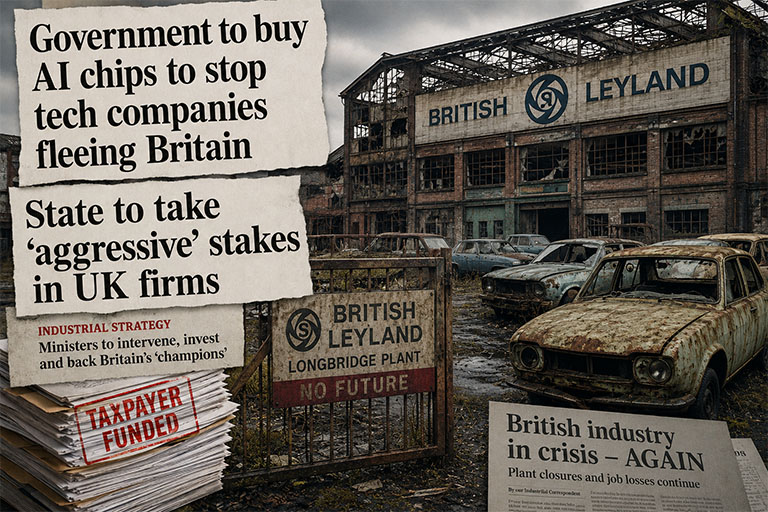
Back to the Future IV: Return of British Leyland
Faced with falling investment and an increasingly hostile business climate, Labour has reached for the only solution it truly understands: more state, more intervention and more bureaucracy. We have seen this experiment before. It failed then, and it will fail again.
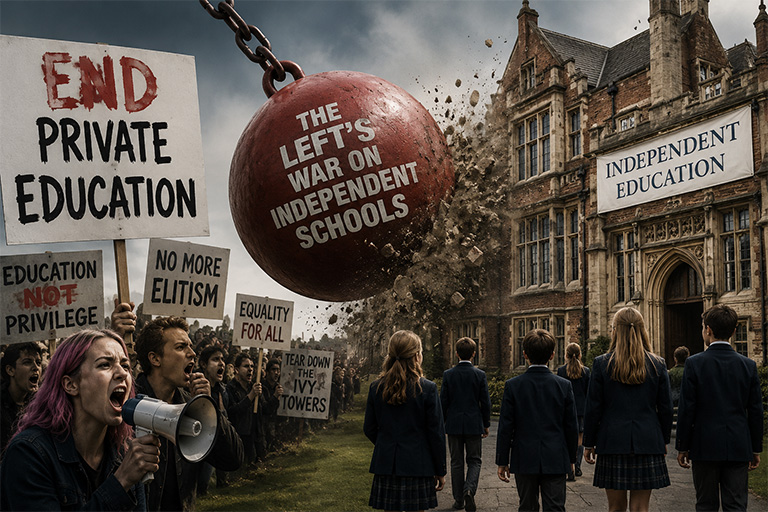
Why the Left Hates Independent Education
The attack on private education is often presented as a crusade for equality. In reality, it is something quite different. Independent schools challenge some of the Left's deepest assumptions about society, proving that parental choice, competition and individual aspiration can outperform state control. That is why the campaign against them persists despite the costs, the consequences and the evidence. The target is not what independent schools do. The target is what they represent.

We Are All Born Capitalists
Capitalism is often portrayed as a modern invention imposed upon society by financiers and corporations. In reality, it is simply the natural extension of ordinary human behaviour: specialisation, cooperation and voluntary exchange. From a Neolithic tribesman trading a stone axe for two fish to the complex global markets of today, free exchange has always allowed individuals to coordinate knowledge, allocate resources and improve living standards more effectively than central planning ever could.