
Back to the Future IV: Return of British Leyland
Whitehall wants to run industry again. What could possibly go wrong?

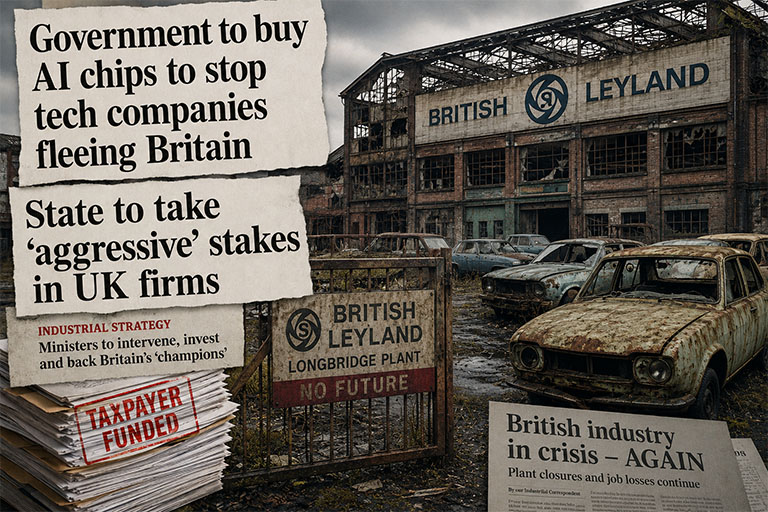
Today, Labour announced the government is planning "strategic purchasing" of AI chips and other hardware. A couple of days ago, they announced that the UK government intends to take larger and more aggressive stakes in private firms. The language coming from Whitehall is increasingly explicit: government will not simply regulate business, it will fund them and it will run them.
If you're not alarmed by this, you're either very young or you have a short memory. Because to many Brits, this should be all too familiar.
What is being presented as bold, modern thinking is in reality a return to ideas that failed spectacularly half a century ago. The last time Labour politicians convinced themselves they could outperform markets, Britain went bankrupt. It is about to happen again.
A nameless, WFH, mid-level bureaucrat is now going to decide how many AI chips the UK needs. It obviously follows from that, that the same bureaucrats must decide which company should have them and when they need them. And the same bureaucrats will decide which companies have access to funding, how much they receive and when they receive it.
But history shows civil servants lack the experience, the commitment, the know-how, the personal interest. A private-sector employee is reportedly around 600 times more likely to be dismissed for incompetence than a government employee. That is not because government employees are 600 times more competent. It is because the state is notoriously poor at removing underperforming staff. These are now the people entrusted to decide business strategy.
More than anything, however, civil servants lack the data. Capitalism has been hugely successful because it is really a system of economic information. Small changes in market conditions filter through millions of people to influence supply and demand. The farmer knows his soil, the chipmaker knows his customers. Prices adjust constantly, as do production resources. No government model can ever replicate this. We know that because it has been tried. It caused breadlines and empty shelves. Any government that convinces itself it can allocate capital or resources more intelligently than private investors risking their own money has lost the plot.
The government throwing taxpayers' money after businesses may look like it is working at first. There may be more companies formed, there may be more paper investments, there may even be more jobs.
That may be all Labour needs. In fact, it may be all they even expect. The next election is a couple of years away. But the businesses created through such schemes aren't competitive businesses, the investments aren't real investments, the jobs won't be there for long. We know it from the COVID loan scandal. Put public money on the table and people will always be willing to collect it. Some will be party insiders. Some will be opportunists. Some will be perfectly honest entrepreneurs responding rationally to the incentives placed before them. The problem is not the character of the people involved. The problem is the system. Businesses that begin life on life-support aren't going to have the strength to survive in a competitive market.
In China and the United States, businesses fight from the very beginning for customers, investment and market share. Their founders often have their entire fortunes tied up in their companies. They grow, expand and survive only because they outperform competitors. Those are the companies Labour's taxpayer-supported champions will compete against. No one can seriously think they will stand a chance. If they survive it will be because more taxpayers' money will be poured into them, year after year. Just like British Leyland. In the end they will end up selling substandard products back to the government.
The biggest worry, however, should be that any of this is necessary in the first place. It may be in Labour's DNA to try to move as many resources under the state's umbrella as possible, but given the government finances at the moment, they're not doing it out of choice. They're doing this because Labour is about to run out of road. Investment is falling, the job market is crashing. Businesses are fleeing Britain. In two years Labour has made Britain a very unattractive place to start, grow and scale a business. Faced with declining competitiveness, excessive regulation, punitive energy costs, rising taxes and an increasingly hostile attitude towards wealth creation, companies are doing what companies always do. They are looking elsewhere.
A government committed to free enterprise would ask how Britain can become more competitive. Can the tax burden be reduced? Can regulations be simplified? Can planning rules be reformed? Can energy costs be lowered?
But those questions require a political trust in markets, competition and private enterprise. Labour does not possess that belief. Instead, Labour has reached for the only solution it truly understands: more state, more intervention, more bureaucracy.
What we are witnessing is not confidence. It is desperation. A government that promised growth has delivered stagnation. A government that promised investment has watched capital leave. A government that promised renewal now finds itself searching for shortcuts.
Unable to make Britain more attractive to business, Labour has decided to subsidise business instead. Unable to create the conditions for success, it intends to manufacture the appearance of success.
Britain tried state-directed industry before. It ended in catastrophic decline, dependency and bankruptcy. We're about to rerun the experiment, and the outcome will be the same.
And once again, the British taxpayer will be left to foot the bill.
Also by Charles H. Thyme

Why the Left Hates Independent Education
The attack on private education is often presented as a crusade for equality. In reality, it is something quite different. Independent schools challenge some of the Left's deepest assumptions about society, proving that parental choice, competition and individual aspiration can outperform state control. That is why the campaign against them persists despite the costs, the consequences and the evidence. The target is not what independent schools do. The target is what they represent.

We Are All Born Capitalists
Capitalism is often portrayed as a modern invention imposed upon society by financiers and corporations. In reality, it is simply the natural extension of ordinary human behaviour: specialisation, cooperation and voluntary exchange. From a Neolithic tribesman trading a stone axe for two fish to the complex global markets of today, free exchange has always allowed individuals to coordinate knowledge, allocate resources and improve living standards more effectively than central planning ever could.

Politics as Religion: Why the Modern Left Cannot Tolerate Dissent
Why does political disagreement increasingly provoke outrage rather than argument? Because for many modern progressives, politics is no longer simply about economics or governance - it has become a moral identity, complete with saints, heretics and sacred institutions. And history suggests that societies rarely emerge peacefully once politics takes on the character of religion.