
We Have Forgotten What Education Is Really For
Britain’s schools are no longer producing truly educated citizens rooted in history, culture and intellectual discipline.
We Have Forgotten What Education Is Really For
Modern Britain talks endlessly about "education", yet increasingly seems to misunderstand what the word actually means.
Today, education is treated as little more than a conveyor belt: exams, qualifications, university places, jobs and salaries. Useful things, certainly. But civilisation cannot survive on utility alone. A society that educates purely for economic output eventually produces technically trained people who know many things, but understand very little.
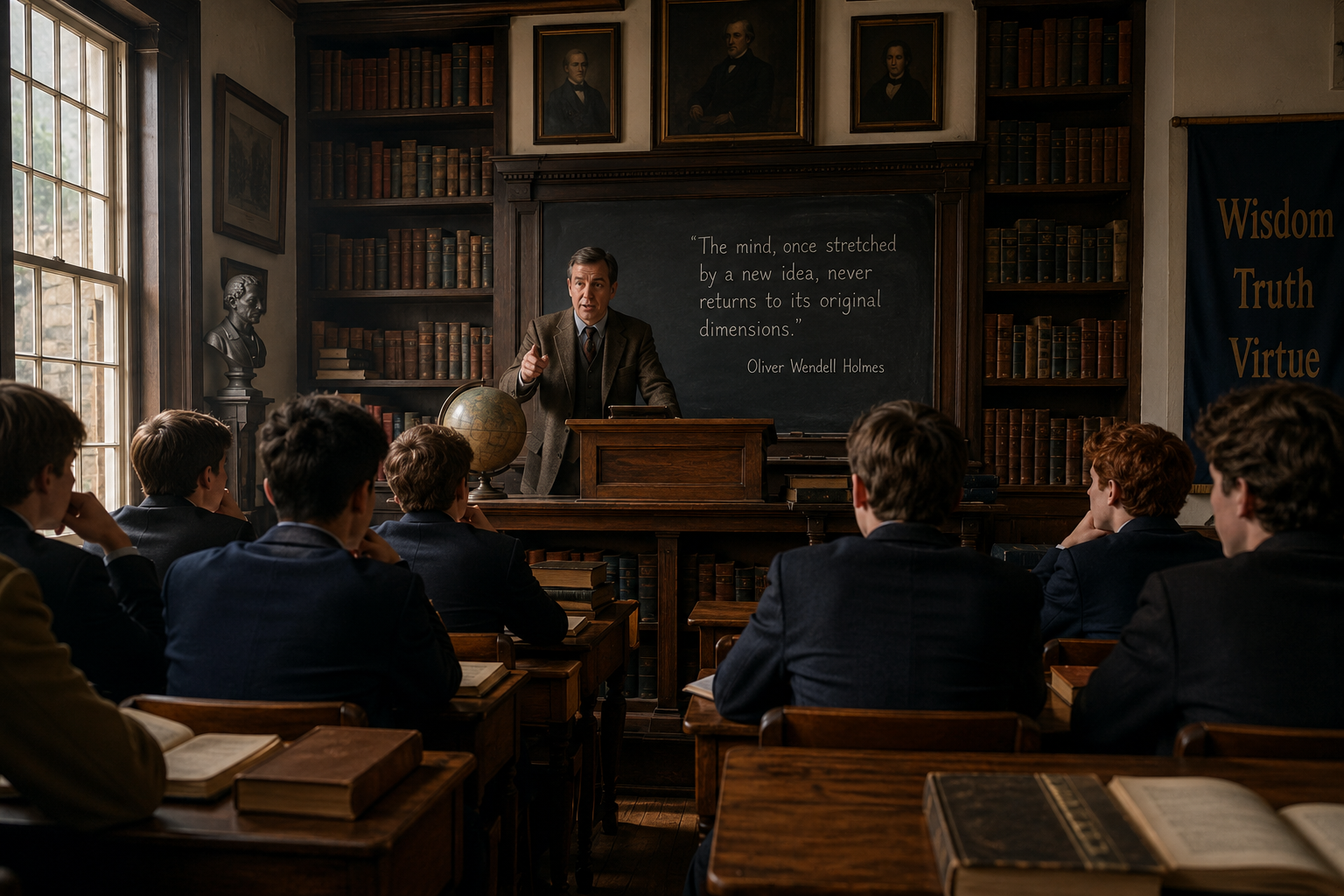
The original meaning of education was far richer. The word comes from the Latin educo — "to lead out". Dr Samuel Johnson defined education not merely as instruction, but as the "formation of manners in youth" and "nurture". In other words, education was once about shaping character, judgement, intellect and moral understanding. It aimed to form complete human beings, not simply efficient workers.
That older understanding is now fading fast.
A Culture Obsessed With Utility
Our modern system increasingly treats children as future economic units. Schools are judged by exam statistics, university placements and employability metrics. Politicians speak endlessly about "skills", while neglecting wisdom, cultural inheritance and intellectual depth.
The result is a generation trained to memorise approved answers rather than challenge ideas, compare viewpoints or wrestle with difficult truths.
I once spoke with an exceptionally intelligent young man from China who had attended one of the country's elite schools. The academic standards were demanding, but the intellectual environment was rigid. Pupils were taught what to think, not how to think. Questioning established views or engaging seriously with conflicting ideas was discouraged.
He eventually came to Britain to study at an English public school. For the first time, he encountered genuine intellectual debate — a living conversation with history, literature and philosophy. He discovered what Matthew Arnold once described as "the best that has been thought and said".
Ironically, many independent schools in Britain still preserve parts of this tradition, while large sections of the state system have abandoned it almost entirely.
The Great Educational Decline
The decline did not begin yesterday, but the Covid lockdowns accelerated it dramatically. Closing schools damaged children's learning, social development and confidence on a massive scale. More importantly, it deepened the confusion about what education is supposed to achieve.
A recent report from the think tank Civitas, titled Renewing Classical Liberal Education, argues that Britain has drifted dangerously far from the educational traditions that sustained Western civilisation for centuries.
The phrase "classical liberal education" does not mean modern progressive liberalism. It refers to an education rooted in the intellectual traditions of Greece, Rome and Christianity — an education centred on freedom of thought, disciplined reasoning and cultural literacy.
For over two thousand years, this tradition helped shape free societies. It encouraged young people to engage seriously with history, philosophy, literature, language and moral questions.
Today, much of that inheritance is being discarded.
Children Know Less About Their Own Civilisation
The statistics are sobering.
In 2024, fewer than 1,000 pupils studied A-level Latin in Britain. Fewer than 200 studied Classical Greek.
GCSE English literature has also been dramatically narrowed. Many pupils now study just a single Shakespeare play, one Dickens novel and a small poetry anthology over two years. By contrast, pupils in the 1950s encountered far broader and more demanding reading lists, including Chaucer and many other foundational works.
The same decline is visible in history teaching.
Large numbers of young Britons now know remarkably little about their own national story. Polling shows that many under-25s know almost nothing about Nelson, Waterloo or the great struggles that shaped modern Britain and Europe. Knowledge of the horrors of Mao's Cultural Revolution is also alarmingly weak.
Instead of providing a coherent understanding of history, modern curricula often jump between disconnected topics while framing the past primarily through grievance, identity politics and ideological activism.
Britain increasingly teaches children to be suspicious of their civilisation rather than understand it.
Freedom Requires Discipline
One of the greatest misconceptions of modern education is the idea that freedom means the absence of standards, rules or inherited wisdom.
The classical liberal tradition believed the opposite.
True intellectual freedom requires discipline: precision in language, clarity in thought and respect for objective standards. A society that loses its ability to think carefully eventually loses its ability to govern itself.
The old educational tradition rejected mindless rote learning, but it also rejected narcissistic individualism. It understood that liberty flourishes best within a culture shaped by responsibility, restraint and shared moral inheritance.
Just as the rule of law protects political freedom, intellectual discipline protects freedom of thought.
Can Britain Recover?
There are signs that many parents instinctively understand what has been lost. In the United States, the growing movement of classical schools shows a renewed hunger for rigorous education rooted in history, literature and serious intellectual challenge.
But rebuilding Britain’s educational culture will not be easy.
For decades, the system has steadily lowered standards while treating genuine scholarship with suspicion or even contempt. Worse still, there are now relatively few teachers themselves who received a truly classical liberal education.
This decline cannot simply be reversed through another Whitehall directive or curriculum reform dreamt up by bureaucrats.
Any real revival must come from the ground up: from teachers who love learning, schools willing to defend high standards and parents who understand that education is about far more than producing employable workers.
A civilisation survives by passing on its intellectual and moral inheritance to the next generation. Once that chain breaks, recovery becomes extremely difficult.
Britain is now discovering the cost of forgetting that truth.
Also by Dominic Harbury

One Rule for Politicians, Another for You
Angela Rayner’s stamp duty case has reignited a growing public suspicion that the political class no longer plays by the same rules as everyone else. While ordinary Britons face relentless penalties and scrutiny from the state, well-connected insiders too often seem to receive understanding, exemptions and leniency.

Starmer’s Britain Is Drifting Back to the Failed Politics of the 60s and 70s
Sir Keir Starmer promised to drag Labour into the modern age. Instead, his government is beginning to resemble a political time machine back to the 1970s: expanding union power, nationalising industry, edging Britain closer to Brussels and piling debt upon debt onto an already stagnant economy. Britain has seen this experiment before — and it did not end well.
Britain Is Losing More Than Titles in the Assault on the Hereditary Peers
The campaign against hereditary peers is presented as democratic progress, yet it threatens to remove some of the House of Lords’ most experienced and independent voices. From distinguished diplomats such as the Earl of Oxford and Asquith to tireless public servants like Lord Russell of Liverpool, Britain is discarding a tradition of duty and expertise in favour of an increasingly shallow political class.